WiseHoots Space Explorer AI Agent
- Purvish Shah
- AI Agents
- 02 Oct, 2026
WiseHoots Space Explorer is a kid-friendly NASA news system. It takes real space data from trusted NASA and JPL sources and turns it into clear, engaging answers for young readers.
The idea is simple: a child asks a space question, and the system responds like a small newsroom. One editor agent coordinates the work, while specialist agents discover sources, check facts, write the explanation, and keep the final answer safe for kids.
Why I Built It
Space information is fascinating, but it is often spread across technical APIs, scientific terms, raw metadata, and measurements that are not written for children.
A simple request like “Give me a NASA story” actually requires several steps:
- Find a trustworthy NASA or JPL source.
- Choose a story that will interest young readers.
- Check the facts, dates, measurements, and safety-related wording.
- Explain the science in simple language.
- Create quiz questions when needed.
WiseHoots Space Explorer wraps those steps into one clear workflow.
The Goal
The goal is to complete the whole process with one API request:
POST /nasa-newsroom
Content-Type: application/json
{
"message": "NASA Story"
}The API returns a structured response that the chat UI can display as a kid-friendly answer, with source-backed details and optional quiz content.
Architecture
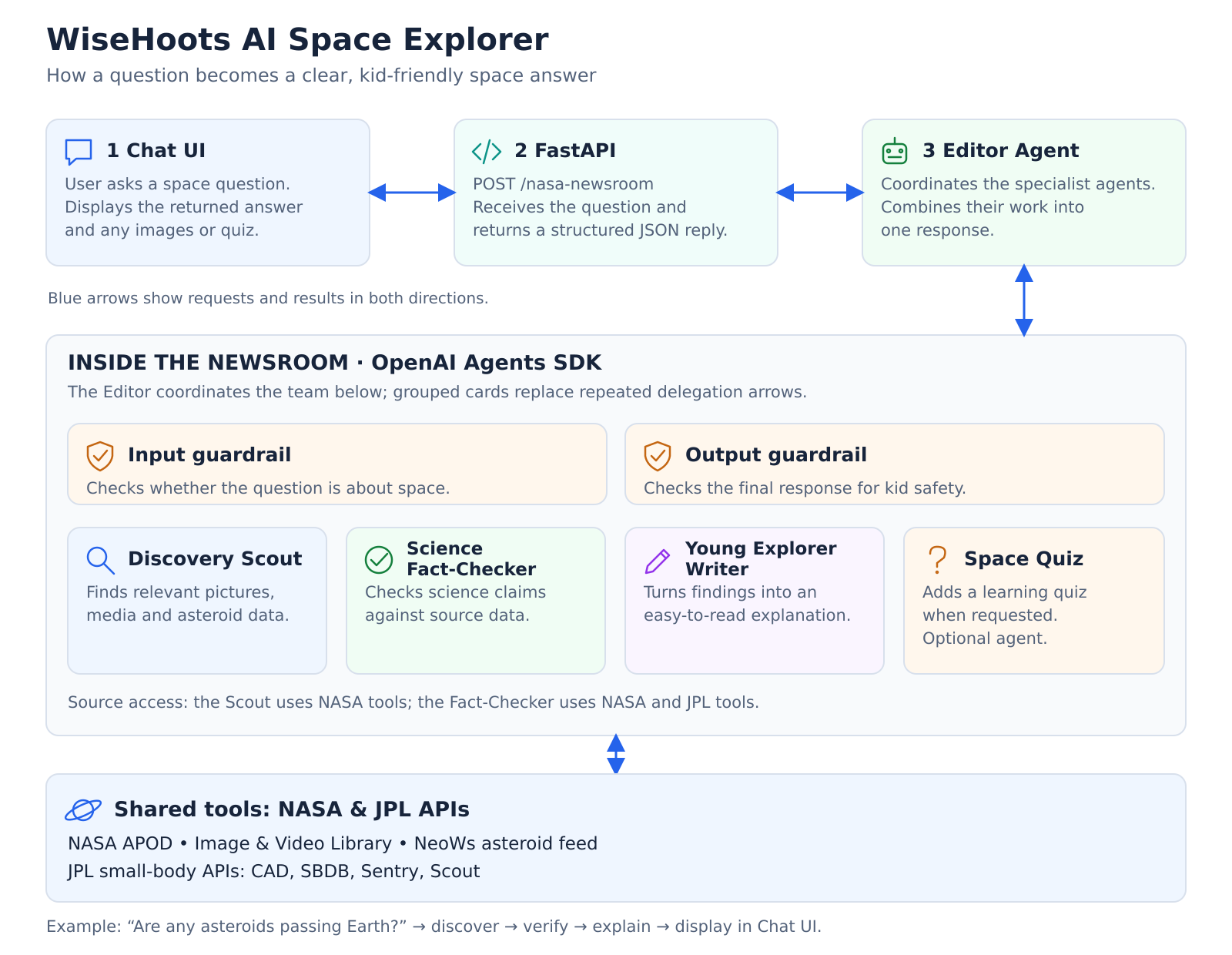
The flow has three main layers:
- The chat UI collects a space question from the user.
- FastAPI receives the request at
/nasa-newsroom. - The editor agent coordinates guardrails, discovery, fact-checking, writing, quizzes, and shared NASA/JPL tools.
How the System Works
Editor Agent
The main agent, NASA Space Newsroom, manages the workflow. It decides which specialist agents to call and combines their work into one final response.
Input Guardrail
Before the system starts researching, it checks that the request is actually about NASA, space, astronomy, planets, asteroids, spacecraft, or space science. Unrelated requests are rejected early.
Discovery Scout
The Discovery Scout finds possible story ideas from trusted sources such as:
- NASA Astronomy Picture of the Day (APOD)
- NASA Image and Video Library
- NASA Near-Earth Object Web Service (NeoWs)
Science Fact-Checker
The Fact-Checker verifies the selected story against NASA and JPL information. It checks:
- Title and publication date
- Source reliability
- Measurements and scientific details
- Unsupported claims
- Asteroid-risk wording
- Confidence level
Young Explorer Writer
The Writer turns verified facts into a friendly explanation for a 9-year-old reader. It uses simple language and relatable comparisons without inventing unsupported details.
Space Quiz Agent
When requested, the Quiz Agent creates two multiple-choice questions and one imaginative question based on the final story.
Output Guardrail
Before the response goes back to the chat UI, the Output Guardrail checks that the content is safe, appropriate, and easy for young readers to understand.
Technical Flow
The request enters a FastAPI application. A Pydantic model checks that the message is present and not empty. The API then runs the newsroom agent and returns structured JSON.
The API also handles common error cases:
- Invalid or empty requests
- Out-of-scope questions
- Fact-checking or safety failures
- Timeouts
- Unexpected internal errors
Why This Architecture Works
This project uses an agent-as-tool pattern. The editor agent stays in control, while specialist agents handle focused tasks.
That separation makes the system:
- Easier to understand
- Easier to test and maintain
- More reliable for fact-checking
- Better suited to age-appropriate writing
- Easier to extend with new capabilities
Summary
WiseHoots Space Explorer turns real NASA and JPL information into educational stories for children. The multi-agent workflow discovers interesting science, verifies the facts, explains them clearly, and can add quiz questions for learning.
The result is a simple newsroom-style system that combines trusted data sources, focused AI agents, and safety checks into one kid-friendly space explorer.